
Stable is having its TGE tonight, will the market still buy into the stablecoin public blockchain narrative?


Original Article Title: "Stable Tonight TGE, Does the Stablecoin Public Chain Narrative Market Still Buy It?"
Original Article Author: 1912212.eth, Foresight News
At 21:00 on December 8th Beijing time, the Stable mainnet will be officially launched. Stable, as a Layer 1 blockchain supported by Bitfinex and Tether, focuses on stablecoin infrastructure. Its core design aims to use USDT as the native gas fee to achieve sub-second settlement and gas-free peer-to-peer transfers. As of the time of writing, exchanges including Bitget, Backpack, and Bybit have announced the listing of STABLE spot trading. In addition, Binance, Coinbase, and Korean exchanges have not yet announced the listing of STABLE spot trading.
Total Supply of 1 Trillion, Tokens Not Used as Gas Fees
Prior to the mainnet launch, the project team has released the whitepaper and tokenomics details. The native token of the project, STABLE, has a total supply of 1 trillion tokens, with the total amount fixed. Stable network transfers, payments, and transactions are settled in USDT, and STABLE is not used as a gas fee but is used for coordinating incentive mechanisms between developers and ecosystem participants. The STABLE token distribution is as follows: Genesis Distribution accounts for 10% of the total supply, supporting initial liquidity, community activation, ecosystem activities, and strategic distribution work; the Genesis Distribution portion will be fully unlocked at the launch of the mainnet.
40% of the total supply is allocated to the ecosystem and community, distributed to developer grants, liquidity programs, partnerships, community initiatives, and ecosystem development; 25% is allocated to the team, including the founding team, engineers, researchers, and contributors; and 25% is allocated to investors and advisors, supporting strategic investors and advisors for network development, infrastructure construction, and promotion.
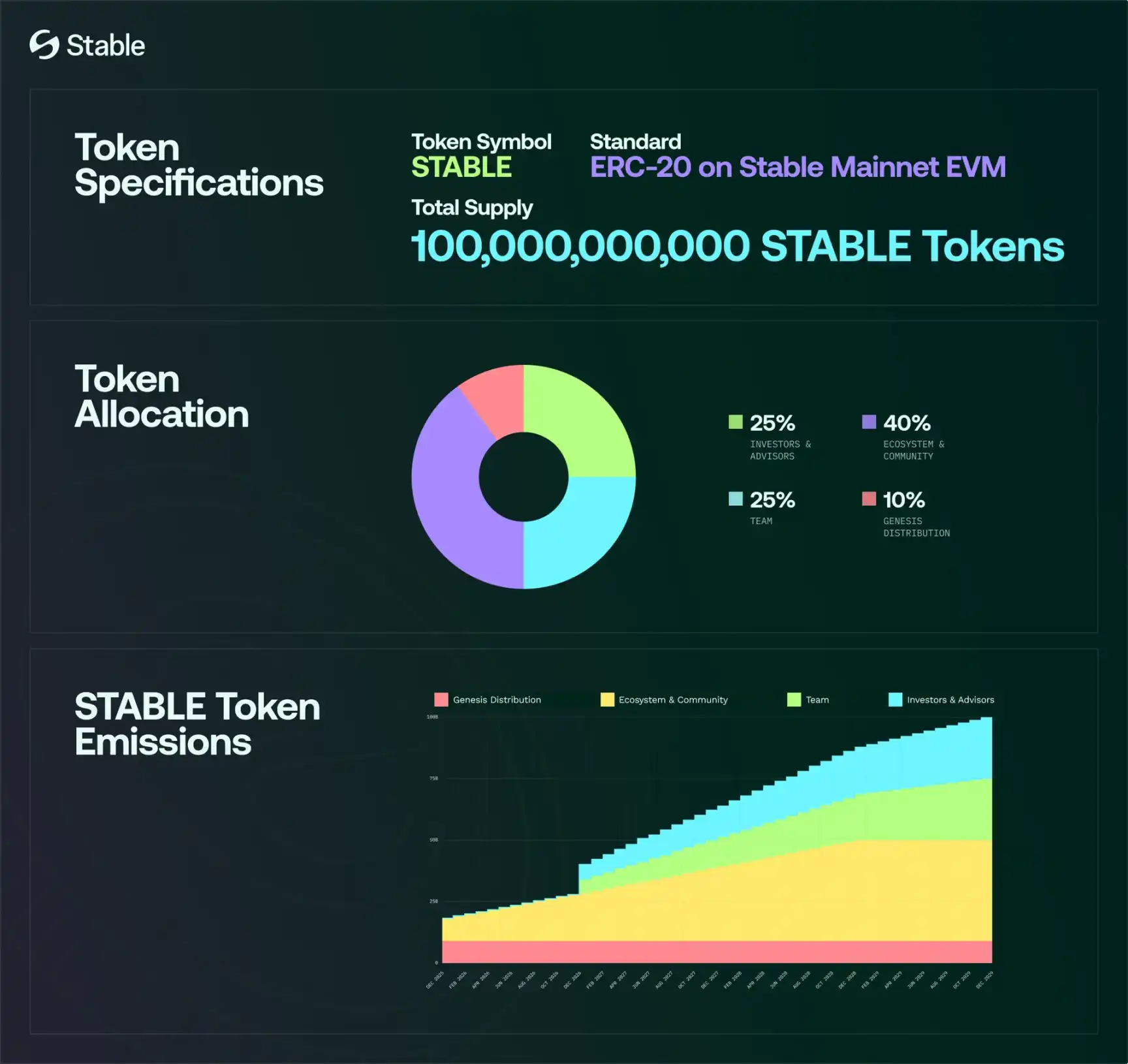
Both the team and investor shares have a one-year cliff period, with zero unlock in the first 12 months, followed by linear release. The ecosystem and community fund share unlocks 8% at launch, with the remaining portion gradually released through linear vesting to incentivize developers, partners, and user growth.
Stable adopts the StableBFT consensus protocol and utilizes a DPoS (Delegated Proof of Stake) model. This design maintains the economic security properties required for a global payment network while supporting high-throughput settlement. Staking the STABLE token is the mechanism for validators and delegators to participate in consensus and earn rewards. The STABLE token's main roles are governance and staking: holders can stake their tokens to become validators, participate in network security maintenance, and influence protocol upgrades through DAO voting, such as adjusting fee rates or introducing support for new stablecoins.
In addition, STABLE can be used for ecosystem incentives, such as liquidity mining or cross-chain bridging rewards. The project team claims that this separation design can attract institutional funds because USDT's stability is much higher than that of volatile governance tokens.
Pre-Deposit Controversy: Insider Trading, KYC Bottleneck
Similar to Plasma, Stable also opened deposits twice before the mainnet launch. The first-phase pre-deposit started at the end of October with a cap of $825 million but was filled within minutes after the announcement. The community questioned some players' insider trading. The top-ranked wallet deposited hundreds of millions of USDT 23 minutes before open deposits.
The project team did not directly respond and opened the second phase of pre-deposit activities on November 6 with a cap of $500 million.
However, Stable underestimated the market's enthusiasm for deposits. At the moment the second phase opened, a massive influx of traffic caused the website to slow down and bottleneck. As a result, after updating the rules, Stable allowed users to deposit through the Hourglass frontend or directly on-chain; the deposit feature reopened for 24 hours, with each wallet able to deposit up to $1 million, with the minimum deposit amount remaining at $1,000.
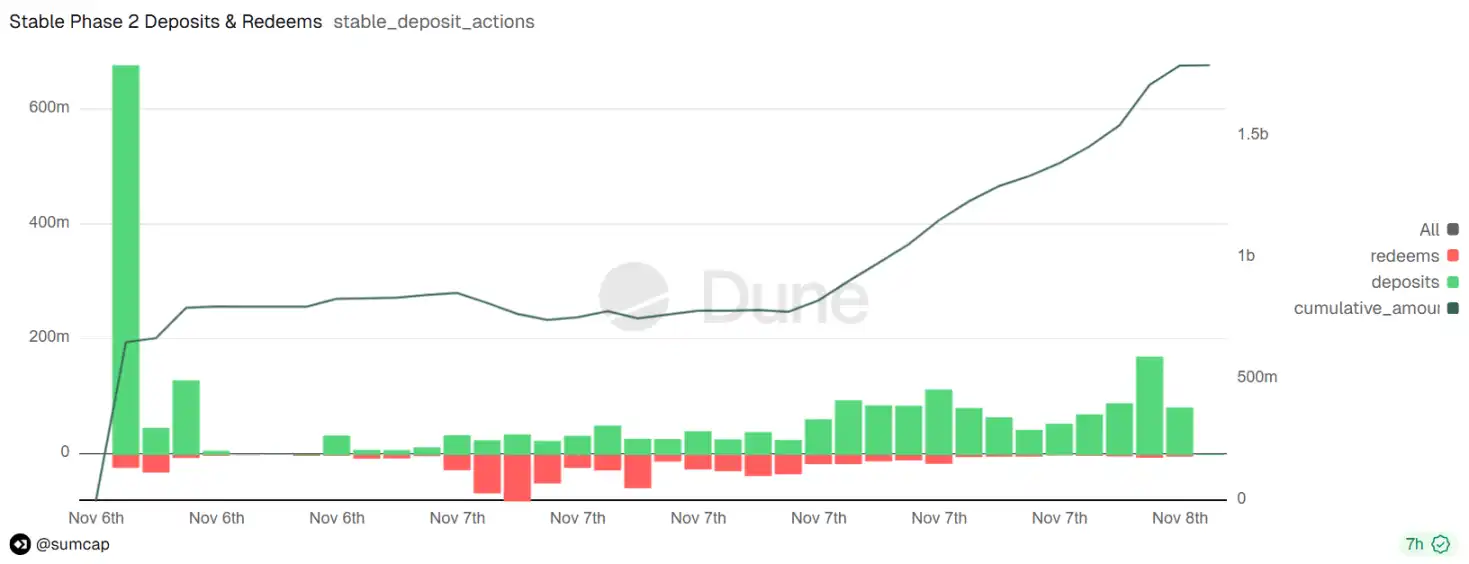
Ultimately, the total deposits in the second phase were approximately $1.8 billion, with around 26,000 participating wallets.
The audit time varied from a few days to a week, with some community users complaining about system bottlenecks or repeated requests for additional documentation.
$20 Billion FDV Probability Over 85%
At the end of July this year, Stable announced the completion of a $28 million seed round of financing, led by Bitfinex and Hack VC, bringing its market valuation to around $3 billion.
By comparison, Plasma's market value is now $3.3 billion, with an FDV of $16.75 billion.
Some optimistic observers believe that the stablecoin narrative, Bitfinex's endorsement, and Plasma's rise and fall may indicate that there will still be some heat and upward price momentum in the near future. However, pessimistic voices are stronger: Gas fees not payable with STABLE, limited utility, especially as the market has entered a bear market cycle where liquidity has become tight, its price may drop rapidly.
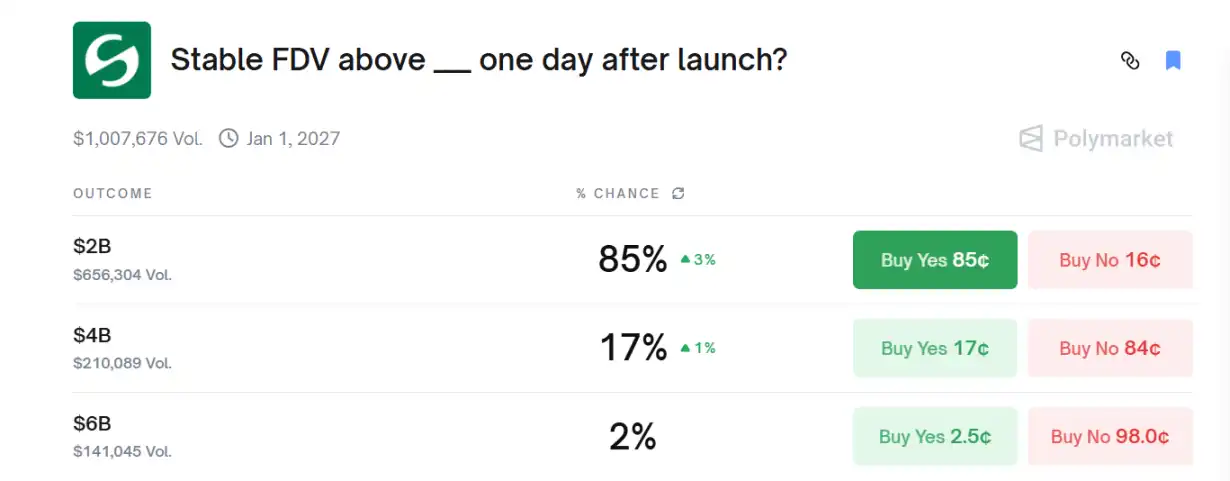
Currently, Polymarket data shows that the probability of FDV exceeding $20 billion after its listing day is 85%. Based on a conservative $20 billion calculation, the STABLE price would correspond to $0.02.
In terms of perpetual contract market, according to Bitget data, the STABLE/USDT is currently priced at $0.032, with its estimated FDV expected to rise to around $3 billion.
The first phase of Stable's pre-deposit reached $825 million, with the actual contribution of the second phase exceeding $1.1 billion, but after proportional distribution, the actual amount entered the pool was $500 million. The total pre-deposit scale is $1.325 billion. The tokenomics disclosed an initial allocation of 10% (used for pre-deposit activity incentives, exchange platform activities, initial on-chain liquidity, etc.). Assuming Stable eventually airdrops a share of 3% to 7% to pre-deposits, calculated based on the pre-market price of $0.032, the corresponding return is approximately 7% to 16.9%. This means that for every $10,000 deposit, the corresponding earnings are $700 to $1,690.
You may also like

Collective Change of Ownership for Crypto Exchanges? The Positioning Competition Among South Korean Financial Giants

a16z Crypto's latest article: Why do we need to predict the market?

Strategy cashes out 2.5 million USD, but Bitcoin's market value dropped by 80 billion USD in one day

WEEXPERIENCE Trading Bootcamp in Poland: How WEEX & FireCrew Are Making Crypto Trading Accessible to Everyone

Paris Reigns Supreme: How PSG Crushed Arsenal’s Dream in a Historic UCL Final Thriller

Full text and analysis of the speech by the CEO of SanDisk at the 42nd Annual Strategic Decision Conference of Bernstein

TaiJi completes $3.5 million strategic financing, with investments from Castrum Capital, Becker Ventures, and Coinvestor Ventures

Bitcoin Stuck Near $73K? How Traders Are Finding Rewards in a Sideways June Market

What Is a Bitcoin ETF? A Simple Guide for 2026

Best AI Crypto Coins 2026: Top 7 Tokens Ranked by Data

How to Stake Solana: A Step-by-Step Guide for 2026

Exclusive Interview with Alpaca CEO: What is the background of the US stock underlying service provider behind Binance and Bitget?
Variant: Three types of L1 assets are highly likely to become the main means of value storage

Does the performance on Perp DEX become an "invisible threshold" and "amplifier" for new coins to go live on CEX?

Zhou Hang: How much is SpaceX really worth?

IOSG: From Coinbase to Upbit: How a Token Completes a 28-Day Journey of Taking Over

Morning Report | Strategy sold 32 BTC and over 800,000 shares of MSTR last week; Binance officially announced its U.S. stock trading portal; Polymarket reached an exclusive partnership with OneFootball

Guaranteed Price Now Live on WEEX: Execute with Greater Precision
Collective Change of Ownership for Crypto Exchanges? The Positioning Competition Among South Korean Financial Giants
a16z Crypto's latest article: Why do we need to predict the market?
Strategy cashes out 2.5 million USD, but Bitcoin's market value dropped by 80 billion USD in one day
WEEXPERIENCE Trading Bootcamp in Poland: How WEEX & FireCrew Are Making Crypto Trading Accessible to Everyone
Paris Reigns Supreme: How PSG Crushed Arsenal’s Dream in a Historic UCL Final Thriller
Full text and analysis of the speech by the CEO of SanDisk at the 42nd Annual Strategic Decision Conference of Bernstein


