
What are some projects to watch for with Ethereum's AI Evolution, ERC-8004 standard?

On January 28, the Ethereum mainnet will see a milestone technical upgrade — the official deployment of the ERC-8004 standard. This is not just a technical protocol release; it also marks Ethereum's attempt to evolve from an asset settlement layer to a global AI Agent's ultimate application store and trust coordination layer.
In the near future, how will we discover new AI Agents to use? What will a decentralized, more open AI ecosystem look like? How will AI Agents facilitate payments for us?
First unveiled in the summer of 2025, a new Ethereum technical standard, ERC-8004, seeks to answer these questions.
Created by MetaMask's AI Lead Marco De Rossi, Ethereum Foundation's AI Lead Davide Crapis, Google engineer Jordan Ellis, and Coinbase Developer Platform Engineering Lead Erik Reppel, this protocol also incorporates feedback and contributions from numerous other crypto companies and projects.
Why Develop the ERC-8004 Standard?
ERC-8004 allows developers to mint AI Agents for users akin to minting NFTs and delegate them via the ERC-721 track. It makes AI Agents discoverable and also enables recording an Agent's reputation score on-chain.
In a traditional internet setting, AI Agents are second-class citizens. They lack bank accounts, identification, and are entirely subject to centralized platform APIs. The emergence of ERC-8004 addresses several key issues:
1. Breaking Down the Silo Effect: Current AI plugins or Agents are trapped in OpenAI's or Google's private ecosystems. ERC-8004 provides a neutral, no-one-owns-it public layer where Agents can exist across platforms.
2. A Credit Society for Machines: Agents are black boxes, and you don't know if an Agent that automates your finances can be trusted. By on-chain reputation recording, negative reviews cannot be erased by the manufacturer, while positive reviews are globally acknowledged.
3. Paying AI: AI can't open a bank account, but it can have an Ethereum address. With ERC-8004's collaboration with the x402 protocol, AI can autonomously purchase computing power, data, or hire other AIs through micropayments, truly becoming an independent economic entity.
In an interview, De Rossi believed: "Perhaps it is too early to fully discuss the business model now. Even though x402 is obviously the best way to monetize the AI Agent, we should focus more on the use cases rather than just the infrastructure."
However, these Agents themselves will not be stored on Ethereum. Running an AI Agent in that way is very complex and would require a lot of additional overhead. So it will not be that thoroughly decentralized form. But ERC-8004 has indeed opened up an intermediate path for developers: between a completely closed ecosystem and a fully open, decentralized system.
In this vision, users or businesses host AI Agents on their own devices or servers; and then use 8004 to leverage the blockchain, sharing their models with others like an open app store and receiving ratings and feedback.
How will Ethereum's upgrade change the user experience?
When Agents have identity and wallets, Ethereum will transition from a speculative tool to a thriving machine-to-machine (A2A) market.
1. AI Agent Cooperation (A2A Economy): You hire a travel planning Agent, which discovers it is not good at finding cheap flights, so it finds a highly reputable flight-hunting Agent on-chain and automatically pays stablecoins to get help, all done in the background.
2. Fully Automated Asset Management: You can authorize a hedge Agent to monitor your wallet. When the market experiences extreme volatility or security threats, based on on-chain verification logic, it can automatically reallocate funds between different protocols without you needing to watch the screen.
3. Decentralized AI Marketplace: You can browse various functional Agents in an Agent browser like in the App Store. As they are in ERC-721 (NFT) form, you can even buy, sell, rent, or stake these highly reputable, highly profitable Agents.
For the average user, the most tangible change is the disappearance of friction and the reduction of trust costs.
In the past, using different AI services required registering for N number of accounts, linking a credit card, obtaining an API Key. Now your wallet is your passport. Agents settle directly through x402, you just need to deposit some stablecoins upfront, no more dealing with complex subscription renewals.
Previously, you had no way of knowing if a certain third-party Agent would secretly take your money or if the advice provided was biased. Now, before using them, you can see the Agent's on-chain "track record" — how many orders they've processed, their success rate, user ratings. This trust is ensured by algorithms, not vendor endorsements.
The most significant change is from "tool interaction" to "Intent interaction." In the past, you needed to swap coins on Uniswap and then deposit them on Aave. Now, you just need to send a message to the Agent: "Help me deposit $1000 into the highest-yielding and lowest-risk option." It will use the ERC-8004 validation mechanism to find the best path and execute all complex operations for you.
If we truly want to attract mainstream consumers, we also need to build some kind of AI Agent browser, a user-friendly frontend, and integrate payment settlement processes. Currently, there are about half a dozen teams working on similar products. However, making a product that is usable by anyone without falling into the trap of platform visibility restrictions for certain types of Agents can be a challenging task.
Davide Crapis, Head of AI at the Ethereum Foundation, stated that Ethereum has a unique advantage in providing security and settlement for AI-to-AI interactions. "The ERC-8004 standard will go live on the mainnet," he said, adding that this release is just the beginning. "February is the month of genesis — it will be very critical."
Which projects are expected to benefit from the ERC-8004 standard?
Ethereum Foundation engineer Binji interprets this upgrade from a more macro perspective, believing that a large-scale AI society needs a shared true ledger.
"The reason civilization can scale is that humans can engage in implicit trust, something AI Agents can't do," he said, describing blockchain as the only viable underlying matrix for Agent society. "ERC-8004 will solidify Ethereum and its L2 as such a blockchain."
It is widely anticipated that this launch will benefit a growing number of AI-focused encrypted projects, especially those working on Agent infrastructure, orchestration layers, and on-chain marketplace platforms.
Analysts and developers typically classify potential beneficiaries into two main categories:
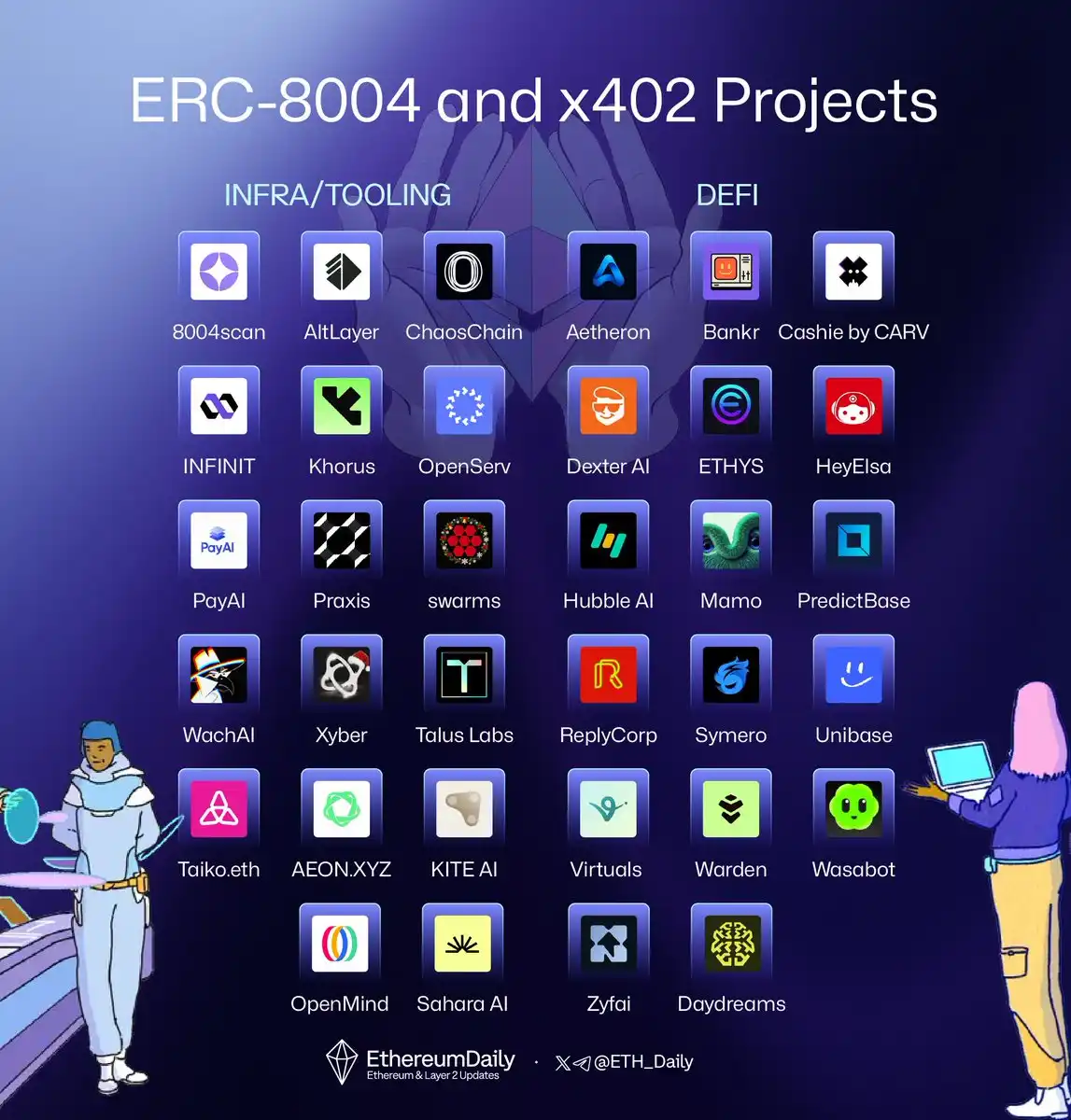
Infrastructure and Tooling Layer
A platform for Agent discovery, orchestration, and reputation tracking. The ecosystem tracker often mentioned directions covering the registry, settlement layer, interoperability, as well as scalability solutions on Ethereum and its Layer-2 networks.
· AltLayer
· ChaosChain
· Tascha
· Khorus
· OpenServ
· PayAI Network | x402 Facilitator
· Praxis
· swarms
· WachAI
· Xyber
· Talus Labs
· Taiko.eth
· AEON.XYZ
· KITE AI
· OpenMind
· Sahara AI
AI Agent Application Layer
Spanning DeFi, prediction markets, automated trading, and autonomous service bots scenarios. These projects rely on Agents that need to authenticate each other, exchange value, and coordinate actions on an open network, which is precisely what ERC-8004 aims to address.
Multiple ecosystem maps circulated within the developer community show that dozens of teams have aligned their products with this standard, hinting at early momentum pre-mainnet activation.
· Aetheron
· Bankr
· Cashie by CARV
· Dexter AI
· ETHYS
· HeyElsa
· Hubble AI
· Mamo
· PredictBase
· ReplyCorp
· Symero
· Unibase
· Virtuals Protocol
· Warden
· Wasabot
· Zyfai
· Daydreams.Systems
x402 Interlinking Effect
The impact of ERC-8004 could be further amplified through close collaboration with x402.
x402 is a protocol for inter-agent "native Internet micro-payments." It revolves around the HTTP 402 response and stablecoin settlements, enabling Agents to make direct payments for API, data, or compute resources without the need for an account, API Key, or intermediary.
Market analysts believe that the combination of the ERC-8004 portable reputation layer and x402's low-friction payment mechanism almost constitutes a complete technical stack for "decentralized AI business."
Some also speculate that as adoption increases, the token demand associated with Agent infrastructure and payment channels may surge.
The global AI market is expected to exceed $1 trillion in 2031. Ethereum's bet is on open, neutral infrastructure, which is more promising than a closed enterprise ecosystem. By anchoring identity, reputation, and settlements on-chain, ERC-8004 aims to position Ethereum as a "coordination layer" for autonomous Agents, not just an application platform.
Whether this vision can translate into sustained network activity and value capture will gradually become clearer in the months following launch. At least for now, ERC-8004 represents Ethereum's clearest attempt to date: to secure a position at the intersection of blockchain and AI.
You may also like

Morning Report | CoinEx becomes a key hub for Iran to evade sanctions, involving over $3.8 billion in funds; Kalshi seeks a new round of financing, with a valuation potentially rising to $40 billion

From the white-haired stock god to the billionaire fund mogul, the smart people shorting Nvidia are all getting rich using the same framework

Why do cryptocurrency projects always like to change their names?

Global Launch: As predictions become the most scarce asset in the AI era, Manadia is defining the next generation of the value internet

Who is footing the bill for the $64 billion accounting frenzy?
I never expected that the first application of AI x Crypto would be in security auditing

What is your view on Binance's competitive advantages?

ETH has entered a non-consensus phase, and the turning point is approaching!
The shift in the cloud of the air: from despising stablecoins a year ago to the high-profile entry of capital today
The survival dilemma of small and medium exchanges behind the withdrawal anomalies exposed by AscendEX

Why Is Bitcoin Falling Below $60K? 5 Key Market Drivers Explained
Bitcoin has dropped sharply amid ETF outflows, Strategy stock weakness, AI stock rallies, and changing Fed expectations. Explore the key forces driving BTC’s latest correction and what traders should watch next.

Bitcoin vs. Gold in 2026: Which Asset Performs Better in Different Markets?

Morning News | The draft amendment to the People's Bank of China Law aims to clarify the legal status of digital renminbi; South Korea will transfer about 40 unregistered virtual asset service providers to law enforcement agencies
The cryptocurrency industry has entered the "Show Me" era: merely relying on vision is no longer enough

Interpreting the Ethereum Foundation's new structure: Reaffirming self-sovereignty amid institutional trends
Former SpaceX engineer reconstructs the financial execution system using first principles
Standard Chartered Bank sings a 50x rhapsody again, aiming for AAVE to reach 3500 USD

Tidal Investment: We still have a positive outlook on the AI industry chain, but the reasons have changed
Morning Report | CoinEx becomes a key hub for Iran to evade sanctions, involving over $3.8 billion in funds; Kalshi seeks a new round of financing, with a valuation potentially rising to $40 billion
From the white-haired stock god to the billionaire fund mogul, the smart people shorting Nvidia are all getting rich using the same framework
Why do cryptocurrency projects always like to change their names?
Global Launch: As predictions become the most scarce asset in the AI era, Manadia is defining the next generation of the value internet
Who is footing the bill for the $64 billion accounting frenzy?
I never expected that the first application of AI x Crypto would be in security auditing


