
「Zero Fee」 Illusion: Lighter Nodes Shifted Costs with High Latency

Original Article Title: Lighter's "0% Fees" Are Actually 5-10x More Expensive Than Other Exchanges
Original Article Author: @PerpetualCow, Crypto Influencer
Original Article Translation: AididiaoJP, Foresight News
There's a saying in the market: If a product is free, then you are the product.
Lighter DEX is currently promoting "zero fees" to retail traders. It sounds too good to be true, and indeed it is.
However, what Lighter didn't prominently display is the toll structure behind these "free" trades.
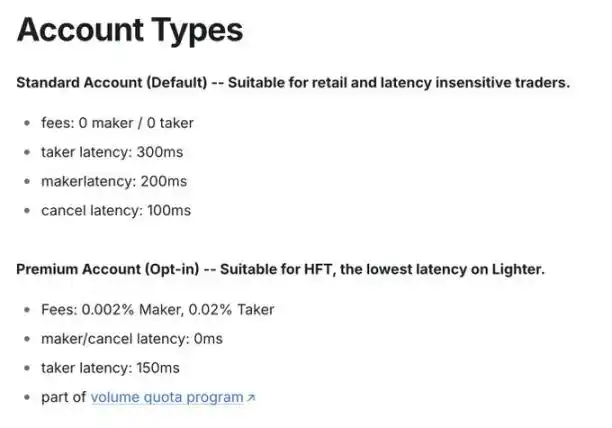
Lighter offers two account types: once you understand how the toll structure works, you'll realize that the 0% fee is actually the most expensive tier on the platform.
That 200-300 millisecond delay is the crux of their business model.
What Does 300 Milliseconds Really Mean?
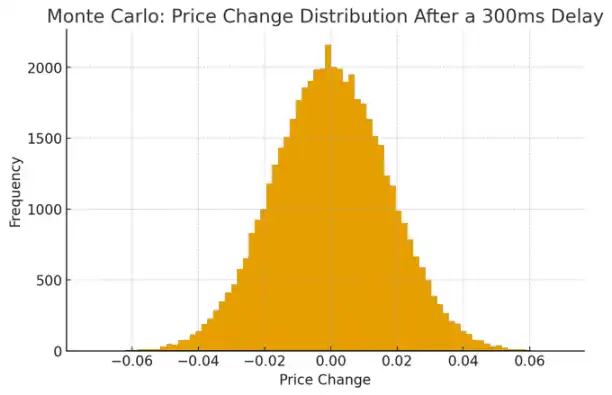
An average human blink takes about 100-150 milliseconds. By the time you blink twice, faster traders have already captured price movements, adjusted positions, and engaged in a trade against you.
The crypto market is highly volatile, with typical volatility levels (50-80% annualized), causing prices to move about 0.5 to 1 basis point per second.
This means that within 300 milliseconds, market noise alone can cause prices to move on average 0.15-0.30 basis points.
The True Cost of "Free"
If we quantify it:
Academic research on adverse selection costs (Glosten & Milgrom, Kyle's Lambda, etc.) indicates that the informational advantage of informed traders is usually 2-5 times the magnitude of price random walk.
If the random slippage within 300 milliseconds is about 0.2 basis points, then adverse selection would add an additional 0.4-1.0 basis points.
For active traders and liquidity providers, the actual costs are roughly as follows:
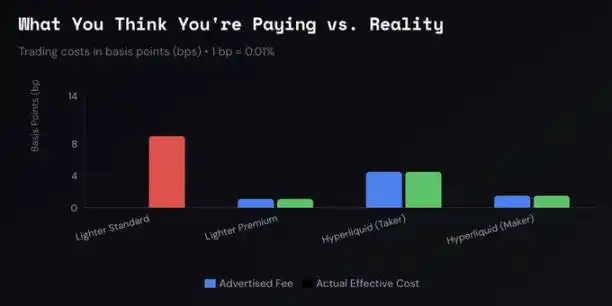
· Standard Account Actual Cost: 6–12 basis points (0.06%–0.12%) per transaction
· Advanced Account Actual Cost: 0.2–2 basis points (0.002%–0.02%) per transaction
The cost of a "free" account is 5–10 times higher than that of a paid account.
Zero transaction fee is just a marketing number; the real cost is hidden in the latency.
The advanced account is actually more cost-effective, without a doubt
In any case, the standard account (0% fee) is not the preferable choice.
It is not suitable for small retail investors, large holders, scalpers, day traders, or even passive investors. Especially not for liquidity providers, or anyone, for that matter.
"I am just a small retail investor; I don't need an advanced infrastructure."
Wrong.
Small retail investors are more vulnerable to slippage. If you trade with $1,000 and lose 10 basis points per trade, it is like losing $1 each time. After 50 trades, 5% of your account will silently disappear.
"I don't trade frequently; latency doesn't affect me."
Also wrong.
If you don't trade frequently, the cost of an advanced account is negligible anyway.
Yet even in a few trades, the execution price you receive is still worse. Since the cost of avoiding such losses is almost zero, why accept any disadvantage?
Directly upgrade to an advanced account.
This model has a precedent
The traditional financial markets have long witnessed this tactic, known as payment for order flow.
@RobinhoodApp once attracted retail investors with "commission-free trading," then routed orders to liquidity providers, allowing them to profit by trading against the uninformed orders of retail investors, thus popularizing this model.
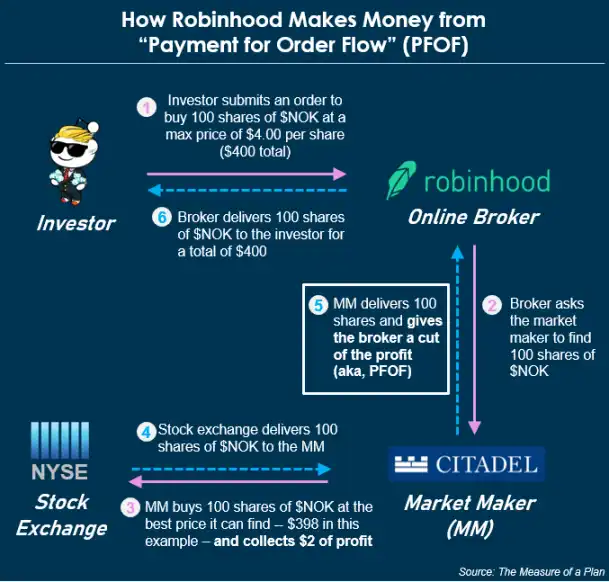
Lighter's model is structurally similar to this. Standard accounts do not receive free trades; they receive slower trades. This latency is transformed into profit by faster participants.
The trading platform does not need to charge you a fee because you are actually paying with execution quality.
What Lighter Did Right and Wrong
Lighter did not conceal latency data, as it was clearly stated in the documentation.
However, transparency does not equal clarity.
By highlighting "0% Fee" in the headline but burying "300ms Latency" in the fine print, Lighter employed a strategy focused on registration conversion rates rather than user understanding.
Most retail traders do not understand the implications of latency, are unaware of adverse selection, and naturally cannot calculate the equivalent actual cost.
Lighter is clear about this.
Advanced accounts are more cost-effective in every way compared to the standard "zero-fee" account—there is no debate about this.
You may also like

Collective Change of Ownership for Crypto Exchanges? The Positioning Competition Among South Korean Financial Giants

a16z Crypto's latest article: Why do we need to predict the market?

Strategy cashes out 2.5 million USD, but Bitcoin's market value dropped by 80 billion USD in one day

WEEXPERIENCE Trading Bootcamp in Poland: How WEEX & FireCrew Are Making Crypto Trading Accessible to Everyone

Paris Reigns Supreme: How PSG Crushed Arsenal’s Dream in a Historic UCL Final Thriller

Full text and analysis of the speech by the CEO of SanDisk at the 42nd Annual Strategic Decision Conference of Bernstein

TaiJi completes $3.5 million strategic financing, with investments from Castrum Capital, Becker Ventures, and Coinvestor Ventures

Bitcoin Stuck Near $73K? How Traders Are Finding Rewards in a Sideways June Market

What Is a Bitcoin ETF? A Simple Guide for 2026

Best AI Crypto Coins 2026: Top 7 Tokens Ranked by Data

How to Stake Solana: A Step-by-Step Guide for 2026

Exclusive Interview with Alpaca CEO: What is the background of the US stock underlying service provider behind Binance and Bitget?
Variant: Three types of L1 assets are highly likely to become the main means of value storage

Does the performance on Perp DEX become an "invisible threshold" and "amplifier" for new coins to go live on CEX?

Zhou Hang: How much is SpaceX really worth?

IOSG: From Coinbase to Upbit: How a Token Completes a 28-Day Journey of Taking Over

Morning Report | Strategy sold 32 BTC and over 800,000 shares of MSTR last week; Binance officially announced its U.S. stock trading portal; Polymarket reached an exclusive partnership with OneFootball

Guaranteed Price Now Live on WEEX: Execute with Greater Precision
Collective Change of Ownership for Crypto Exchanges? The Positioning Competition Among South Korean Financial Giants
a16z Crypto's latest article: Why do we need to predict the market?
Strategy cashes out 2.5 million USD, but Bitcoin's market value dropped by 80 billion USD in one day
WEEXPERIENCE Trading Bootcamp in Poland: How WEEX & FireCrew Are Making Crypto Trading Accessible to Everyone
Paris Reigns Supreme: How PSG Crushed Arsenal’s Dream in a Historic UCL Final Thriller
Full text and analysis of the speech by the CEO of SanDisk at the 42nd Annual Strategic Decision Conference of Bernstein


